
Let’s start with a truth that rarely gets said out loud.
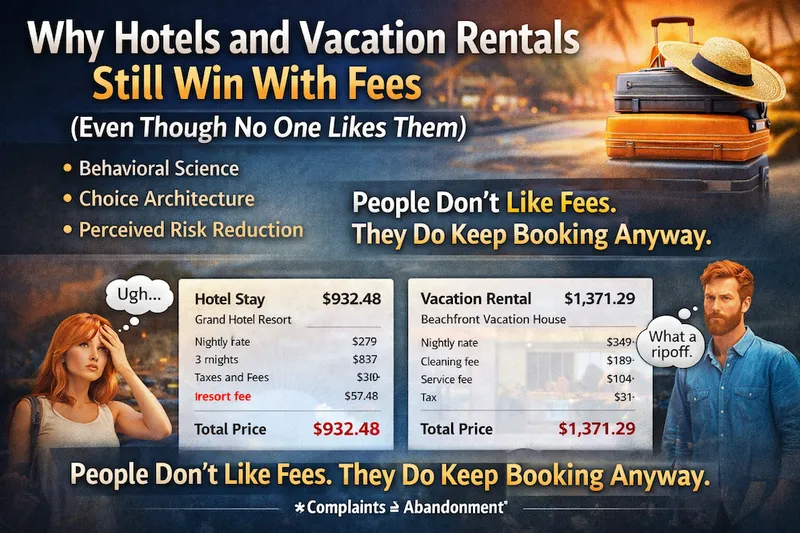
People do not like booking fees.
They never have.
They complain about them constantly.
And yet, hotels and vacation rentals keep charging them, and people keep booking anyway.
That’s not because travelers suddenly decided fees are fair.
It’s because human behavior is shaped less by preference than by expectation and choice architecture.
People Don’t Respond to Prices, They Respond to Context
From a behavioral science standpoint, fees survive in hotels and vacation rentals because the context trained people to tolerate them.
Hotels have charged taxes, resort fees, parking fees, and destination fees for decades. Vacation rentals followed with cleaning and service fees that quickly became universal.
Over time, travelers stopped asking “Why is there a fee?” and started asking only one question:
“Is this normal for this kind of booking?”
Once the answer becomes “yes,” the emotional fight is over.
The fee may still feel annoying, but it no longer feels negotiable.
That is classic behavioral conditioning.
Repeated exposure turns irritation into acceptance, not approval.
When There’s No Clear Alternative, People Move Forward

People don’t want complexity, they want clarity and momentum.
In hotels and vacation rentals, avoiding fees is nearly impossible.
- Many charge mandatory resort or destination fees.
- Every major vacation rental platform includes cleaning and service fees and other fees..
- Switching brands or platforms rarely removes fees, it just changes how they’re labeled.
When every road leads to the same outcome, people stop fighting the road and keep walking.
At that point, the customer story changes from
“I don’t like this fee”
to
“Which option is best overall?”
That shift is why total price comparison dominates booking behavior today.
Risk Reduction Is the Silent Hero
Hotels and vacation rental platforms didn’t eliminate fees.
They eliminated fear.
Free cancellation, pay-later options, loyalty points, member pricing, and price guarantees all do the same thing psychologically:
They tell the customer,
“You’re safe to move forward.”
Behavioral research consistently shows that people will accept higher costs when perceived risk is lower. This is why data from major platforms shows travelers still booking even as total prices rise.
The fee doesn’t disappear.
It just stops being the main character.
Why Complaints Don’t Equal Lost Bookings

Here’s the counterintuitive part that trips people up.
Resort fees and cleaning fees remain among the most complained-about charges in travel. Review sites, surveys, and social media confirm that frustration is real.
But booking volume doesn’t drop in proportion.
That’s because complaints often signal powerlessness, not intent to leave.
When consumers believe they cannot change the system, they vent, then comply. In economic terms, demand becomes less sensitive to how the price is structured and more sensitive only to the final number.
People don’t have to like the system to operate within it.
Acceptance Is Not Approval, and That’s the Point
Hotels and vacation rentals didn’t win the argument on fees.
They won the environment.
Fees persist because:
- they are expected,
- they are unavoidable,
- they are normalized by comparison tools,
- and they are softened by flexibility and loyalty mechanisms.
This is not about fairness.
It’s about behavioral gravity.
When enough friction-free alternatives disappear, resistance turns into routine.
The Takeaway That Matters

Fees don’t work because people don't like them.
They work because people adapt faster than markets change.
Once a pricing structure becomes standard, human behavior adjusts, even if emotions lag behind.
That is why hotels and vacation rentals “get a pass.”
Not because travelers approve.
But because the system removed the option to object in any meaningful way.
And in human decision-making,
no choice is often more powerful than a good argument.
Contact us today to learn about how we can help boost your business.