

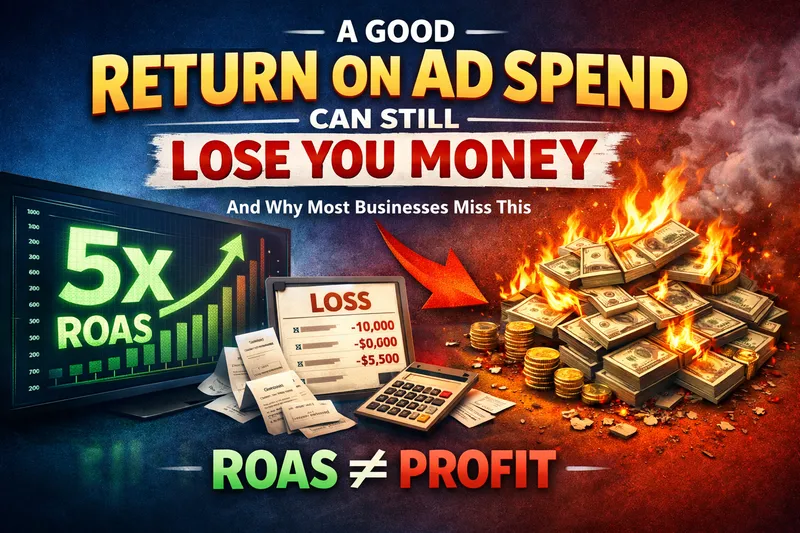
ROAS is one of the most abused metrics in marketing. ( Return On Ad Spend )
Not because it is useless, but because people treat it like a scoreboard instead of a tool.
A 5x ROAS looks great in a dashboard. It looks great in a report. It looks great in a sales pitch.
And it can still be losing you money.
ROAS Does Not Equal Profit
ROAS only answers one question:
“How much tracked revenue did the platform attribute to my ad spend?”
It does not tell you:
- If the sale was profitable
- If margins covered fulfillment and overhead
- If the customer ever buys again
- If sales actually followed up
- If attribution was even accurate
That is why two businesses can have the same ROAS and completely different outcomes.
One grows. One bleeds.
How High ROAS Campaigns Lose Money
We see this constantly.
High ROAS campaigns that quietly destroy margin because:
- The front-end offer has low margins
- There is no upsell, retention, or backend monetization
- Sales follow-up is slow or inconsistent
- Marketing and sales are not connected
- Attribution gaps hide real costs
The ads look efficient. The business does not.
Every new sale adds complexity, labor, and cost without adding real profit.
Why a Lower ROAS Can Be Smarter
Some of the most scalable systems run on what looks like a “bad” ROAS.
Sometimes 2x. Sometimes lower.
That works when the business has:
- Strong gross margins
- Fast and reliable lead follow-up
- Clear sales ownership
- High lifetime value
- Repeat purchases or upsells
In those systems, ads are not meant to win upfront. They are meant to feed a machine that compounds revenue over time.
ROAS is just the entry fee. The profit comes later.
Ads Do Not Work in Isolation

Ads do not fail on their own. Systems fail.
Ad performance is inseparable from:
- Offer positioning
- Landing page clarity and speed
- CRM and pipeline setup
- Email and SMS automation
- Sales response time
- Customer lifetime value
If any one of those breaks, ROAS becomes a vanity metric.
That is why copying a competitor’s ads almost never works. You are copying the wrapper, not the machine behind it.
Platform Metrics Are Incomplete
Another uncomfortable truth.
Ad platforms do not show the full picture.
- Attribution windows vary
- Post-iOS tracking is inconsistent
- Offline conversions are often missed
- Longer sales cycles rarely show up correctly
If you make decisions solely from an ad dashboard, you are operating with partial data and full confidence. That is a dangerous combination.
How ROAS Should Actually Be Used
ROAS still matters, but only in context.
We treat it as one signal inside a larger system that tracks:
- Cost to acquire a customer
- Lead-to-sale conversion rates
- Revenue per lead
- Lifetime value
- True profitability
When ads, sales, and operations are aligned, ROAS becomes useful again. Not as a trophy, but as guidance.
The Only Metric That Matters
You do not run ads for screenshots.
You run ads to grow profit.
If your ROAS looks great but cash feels tight, the ads are not the problem. The system around them is.
Fix the system, and ROAS starts working for you instead of lying to you.
That is how you scale without burning margin. Contact us today to learn more about how IMEG can help your business.