

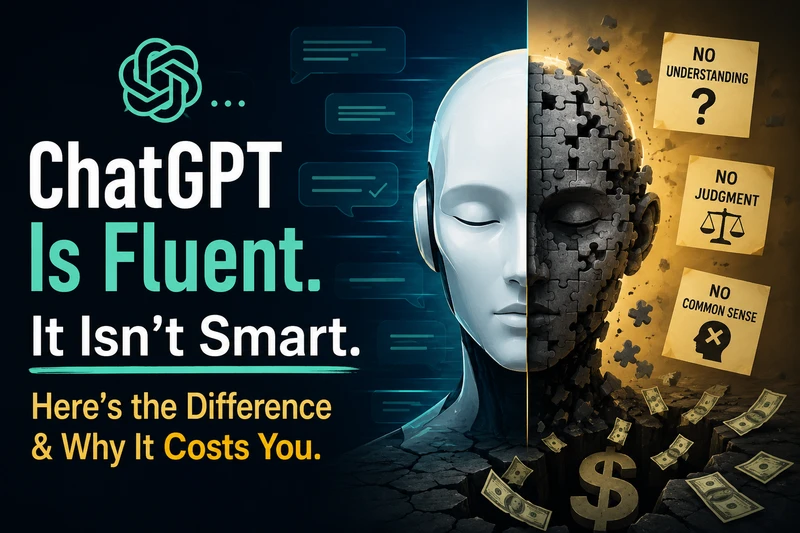
There's a distinction that changes everything once you understand it, and almost nobody in business talks about it honestly.
Fluent means it can say anything in perfect, confident, well-structured sentences. Smart means it knows whether what it's saying is true, relevant, and actually useful for your specific situation. ChatGPT is the most fluent thing ever built. It has no reliable relationship with truth, relevance, or your market whatsoever.
Those sound like the same thing. They are completely different. And the gap between them is where most AI-generated marketing quietly fails.
What fluent without smart actually looks like
When you paste a topic into ChatGPT and hit generate, here's what you get. A well-structured piece of content written in confident, professional prose that sounds authoritative, reads cleanly, and looks exactly like something worth publishing.

Here's what you don't get. Any knowledge of what your customers are actually searching for right now. Any understanding of who you're competing against and what their content is doing that yours needs to beat. Any connection to your specific business, your offers, your highest-converting pages, or the voice your brand has built over the years. Any structured data that tells Google what the content is and how to surface it. Any answer blocks formatted for AI Overviews, where a growing share of search traffic now gets resolved before anyone clicks through to a website. Any internal links wired to your conversion flow. Any compliance check against your brand requirements. Any reoptimization plan for when the content starts to decay six months after it publishes.
What you get is words. What you need is a system. And fluency is not a system.
Why this matters more than most people realize
Here's the number that reframes the whole conversation. Studies consistently show that over 90% of all content published online receives zero organic traffic from Google. Not a little traffic. Zero. Nine out of ten pages ever written are completely invisible from the moment they are published.
Not because the writing was bad. Because writing and ranking require completely different work. And ChatGPT only does one of them.
Ranking requires knowing exactly what your audience is searching for right now, not six months ago, not what seems reasonable, but what the live data shows people are actually typing today. It requires mapping the competitive landscape for every term you're targeting, who's ranking, what their pages contain, what they're missing, and where a genuine gap exists that your content can fill. It requires structured data, answer blocks, heading hierarchy, internal link architecture, entity coverage, and a pre-publish audit that checks dozens of signals before anything goes live. And it requires active maintenance after publication, because content that isn't watched and reoptimized decays, and the gap between where it ranked at launch and where it sits six months later represents real traffic and real revenue walking out the door.
ChatGPT does none of that. It produces the output and stops. Everything that determines whether that output actually performs is outside what it can do, understand, or even know is missing.
The part that makes it genuinely dangerous
This is where it gets important. ChatGPT doesn't know what it doesn't know. It has no internal sense of uncertainty. It doesn't flag the things it's guessing at or the things it got wrong. It delivers a fabricated statistic, an inaccurate competitive claim, a keyword you have no shot at ranking for, or a content structure built around the wrong search intent in exactly the same confident voice it uses when everything is correct.

For a business, this isn't a minor risk. A marketing plan built on inaccurate keyword targeting wastes months of effort and budget. A blog post structured around the wrong search intent will never rank, regardless of how well it's written. A competitive analysis that misses the most important players in your market sends your strategy in the wrong direction from the start. And because the output always looks professional and authoritative, most people have no way to know any of this until the results make it undeniable, usually six to twelve months later, when the traffic hasn't moved, and nobody can explain why.
And here's the deeper problem on top of that. Most people using AI for marketing have never actually done marketing. They've never built a keyword strategy, run a competitive analysis, structured a piece of content for search intent, or connected a blog post to a conversion flow. They don't know what good output looks like because they've never produced it without the tool. So when ChatGPT gives them something that sounds confident and professional, they have no frame of reference to evaluate it. The expertise to catch what the model gets wrong is the only protection against building a strategy on top of things that aren't true. Without it, fluency looks like intelligence. And that's the most expensive mistake a business can make.
What smart actually looks like behind the fluency
Here's what happens when expert judgment sits behind the AI output instead of in front of it, hoping for the best.
Before a single word gets written, live keyword data gets pulled and interpreted by someone who knows which terms are winnable in your specific competitive position and which ones only look that way. Competitive gap analysis maps what's ranking, what it contains, and where your content has a genuine shot. A three-phase crawl of your site loads your actual business, your actual pages, your actual offers, and your actual brand voice into the process so the draft knows what it's writing about and who it's writing for.
The draft then goes through a 30+ point audit covering content quality, SEO fundamentals, AEO and citation readiness, technical SEO, content strategy, and compliance before anything publishes. Structured data gets implemented correctly. Answer blocks get formatted for AI Overview extraction. Internal links get wired to your conversion flow. Meta titles and descriptions get written to earn the click, not just to describe the post.
After it publishes the reoptimization loop watches performance through your Google Search Console data, identifies posts that are losing ground, and pulls them back through the process before the decay becomes visible in your traffic numbers. And every post gets repurposed across 12+ platform variants automatically, so one piece of content becomes a full distribution strategy across every channel your audience uses.
That's what smart behind the fluency looks like. That's the difference between content that exists and content that performs.
The one-line version

ChatGPT is a great starting point. It is not a content strategy. The starting point is about 10% of the job. We do the other 90%.
Here's your next step:
Book a free content audit.
Thirty minutes. Your actual data. A clear picture of where you stand.