
There are no shortcuts. And the shortcut to all shortcuts is that there are no shortcuts.
That's the thing nobody in the AI hype cycle wants to say out loud. Every vendor, every conference keynote, every trade publication is selling the same story: deploy AI, cut costs, move faster, win. And everyone is buying it, including some of the biggest companies in the world.
The results are starting to come in. They are not pretty.
When Everyone Has the Same Tool, Nobody Has an Advantage
AI is not a competitive moat. If your competitor can buy the same platform for $99 a month, you haven't gained an edge; you've reached table stakes. The advantage was never the tool. It was always the strategy, the data, the experience, and the people behind it. AI doesn't change that. It amplifies it.

There is one exception worth naming: proprietary data and deep domain experience fed into AI tools are not commodities. A company with years of industry pattern recognition, client history, and first-party data running through an AI system has something a competitor cannot buy off the shelf. The tool is commoditized. The inputs aren't. That gap is where real advantage lives.
Which brings us to the uncomfortable truth that the industry won't put in a case study: AI makes sharp people sharper and sloppy people sloppier. Hand a 20-year hospitality marketer an AI toolkit, and you get something dangerous in the best way. Hand that same toolkit to someone trying to fake 20 years of experience, and you get confident, fast, and wrong. The gap between those two outcomes just got bigger, not smaller.
The Failures Aren't AI Problems. They're Strategy Problems.
The brands that got burned in 2025 and 2026 didn't fail because AI is bad. They failed because they pointed AI at the wrong problems and removed the human judgment that was holding things together.
Pizza Hut deployed an AI delivery management system that gave third-party drivers visibility into kitchen timing. Experienced managers lost operational control. Drivers started batching orders. Average delivery times jumped from 30 minutes to 45. A top-performing franchisee watched its market flip from +10% to -9.78% sales growth in a single quarter. That wasn't a slow delivery problem. It was a third-party driver incentive problem. AI didn't create it. AI accelerated it. The franchisee is now suing for $100 million.
Klarna replaced 700 customer service agents with a chatbot, watched satisfaction scores drop, and reversed course within two years. The CEO's explanation: "We focused too much on efficiency and cost." Translation: they pointed AI at a problem that required empathy and accountability, two things algorithms don't have.
UnitedHealthcare used an AI tool to manage Medicare Advantage claims. Plaintiffs in a federal class action allege the tool overrode physician decisions and denied medically necessary care with a 90% error rate. Some patients died. A federal judge ordered broad discovery in March 2026. When AI makes a life-or-death call, someone still has to be accountable. The lawsuit is a fight over exactly that question.
McDonald's ended a two-year AI drive-thru partnership after viral videos showed customers receiving hundreds of McNuggets they never ordered. Separately, its AI hiring chatbot exposed 64 million job applicants' personal data because the vendor left the admin password as "123456." Sophisticated AI, elementary negligence.
Starbucks deployed an AI inventory tool to 11,000+ stores. Killed it eight months later without explanation.
Waymo recalled nearly 5,000 robotaxis in the past year after vehicles crashed into road barriers and drove into flooded roads at highway speed. One was swept into a creek. Speed without the right guardrails just means you fail faster.
Garbage In, Garbage Out Still Applies
AI doesn't fix bad data, bad processes, or bad strategy. It amplifies them. Every one of the failures above had a root problem that existed before AI showed up. AI made it bigger, faster, and harder to walk back.
If your marketing data is messy, AI-generated insights will be confidently messy. If your customer service culture is indifferent, an AI chatbot will be indifferently efficient. If your operations have a gap, an algorithm will find it at scale before you do.
What AI Is Actually Good For
To be clear: AI is a legitimate and powerful tool. There are jobs where it beats humans every time. Processing large volumes of data. Recognizing patterns across thousands of touchpoints. Maintaining consistency at scale. Responding at 3 AM. Those are real advantages, and companies that apply AI to those problems will win.
The failure happens when AI gets pointed at things that require judgment, empathy, experience, and accountability. Those aren't bottlenecks to automate around. They're the product.
Crawl. Walk. Run. Kill It Fast If It Fails the Crawl.
One thing every failure on this list has in common: companies skipped the pilot and went straight to full deployment. Pizza Hut rolled out across its franchises. Starbucks went to 11,000 stores. McDonald's ran it for two years before pulling the plug. By the time the damage was visible, it was already expensive.
The practical framework is simple. Start with a controlled test on a problem that won't break anything critical if the AI gets it wrong. Measure it honestly against the baseline. If it doesn't win the crawl, kill it and move on. If it does, walk it into a broader rollout with human oversight still in place. Run only after you've earned that confidence with real data.
This isn't caution for caution's sake. It's how you avoid being the next case study.
How We Think About It
At IMEG, we've spent over 23 years helping businesses across industries grow through digital marketing. We've built our own AI tools under our Jupiter Mind platform because we believe AI applied to the right problems, with experienced people behind it, creates real leverage for any business.

We work with hospitality brands, healthcare providers, home services companies, professional services firms, retail businesses, and everything in between. The AI principles don't change by industry. The problems worth solving with it do.
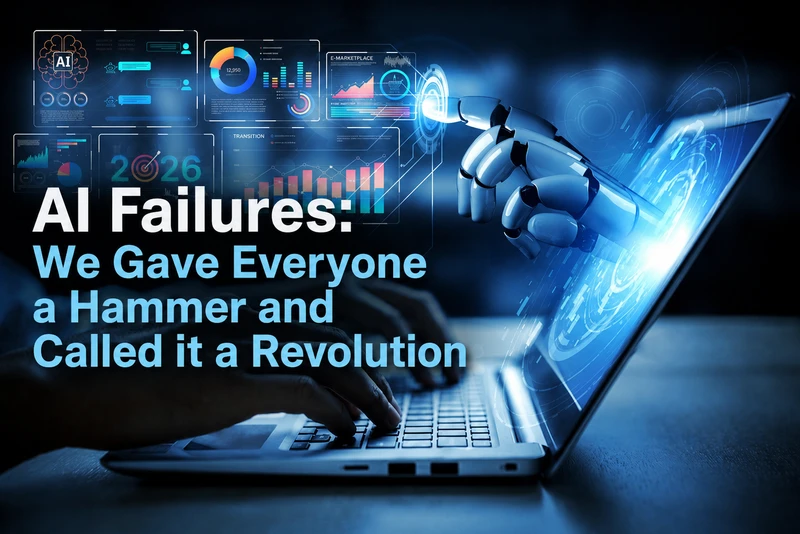
We're not selling AI for AI's sake. We're not handing anyone a hammer and calling everything a nail.
If you're evaluating an AI investment and want a straight conversation about what it will and won't do for your business, that's exactly the kind of conversation we have every day.