

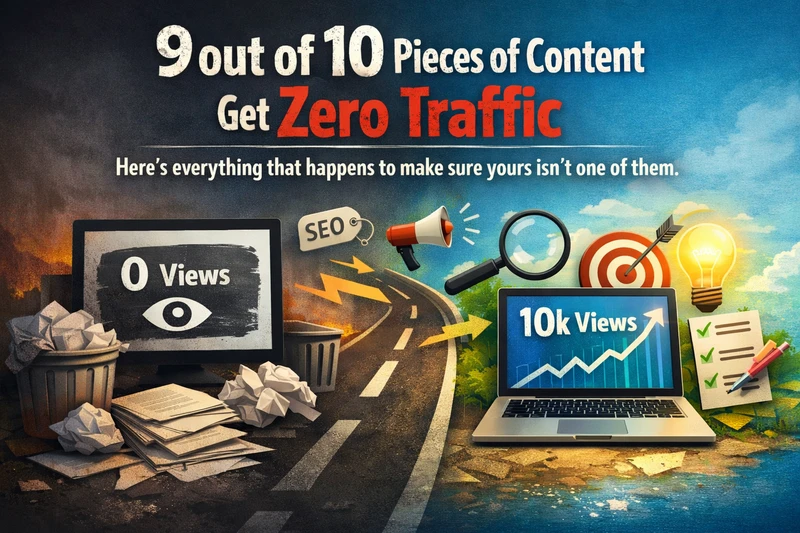
Before we tell you what happens inside our content process, one number is worth sitting with.
Studies consistently show that over 90% of all content published online receives zero organic traffic from Google. Not a little. Zero. Nine out of ten pages ever written are completely invisible from the moment they go live. The agencies producing them are still sending invoices.
You've approved posts. You've seen the finished pieces. You know what content looks like when it comes out the other side. What most clients never see is everything that happens before the first word is written and everything that happens after the last one. And that everything is the only thing that puts your content in the 10% that actually performs.
Here's what actually happens.
Writing is the easy part. Ranking is the hard part. We do both.

Most content services sell you writing. We sell you an outcome. Those are different products at a different price for a different reason, and it's worth being direct about why.
Writing content and ranking for it require completely different work. A well-written post with the wrong keyword targeting, no structured data, no competitive positioning, and no maintenance plan will join the 90% of content that gets zero traffic, regardless of how good the writing is. The words are the easy part. Everything surrounding the words is what determines whether anyone ever reads them.
Here's what that work actually looks like inside our system.
Before anyone writes anything
The moment a new content piece enters our process, the first thing that happens has nothing to do with writing. It has to do with your market.
Our ClusterPlanner groups related keywords into topic clusters, and our DataForSEO integration pulls live search results and computes opportunity scores for every potential target. We're looking at real search volumes, real keyword difficulty, and real SERP data pulled at the moment of planning. Not assumptions. Not experience substituting for data. Not topics that seem reasonable. What your customers are actually typing right now, how many of them, and whether you have a realistic shot at ranking for it.
This alone changes what the piece is about more often than clients expect. The topic you suggest, and the topic that will actually drive traffic, are frequently not the same thing. Without live data, you're guessing. And you're paying for the guess.
Then we run competitive analysis on the top-ranking pages for every target term. We look at what those pages cover, how long they are, what questions they answer, what they're missing, and where a genuine gap exists that your content can fill. Without this analysis, you're competing head-on against pages that have years of authority behind them instead of targeting the angles where you have a real shot.
Then our Knowledge Bridge runs a three-phase crawl of your site. We map your existing pages, your highest-converting content, your internal link structure, your offers, your products and services, and the language you use about your brand. All of that gets loaded into the process before writing starts, so every draft knows what your business actually is, what pages it should connect to, and what voice it should carry. This is the difference between a post that could have been written for any business in your category and one that could only have been written for yours.
All of this happens before a single word of the post exists.
It's worth saying directly: every tool that powers this process is technically available to anyone. Anyone can pull a keyword report. Anyone can ask an AI to map competitors or suggest a content structure. But knowing what to do with what comes back, knowing whether a keyword is worth targeting or a trap, knowing what the competitive data actually means versus what it appears to mean on the surface, knowing which gaps are genuine opportunities and which ones look winnable and aren't; that judgment doesn't come from the tools. It comes from years of applying them across enough markets and enough client situations to know the difference between a result that looks right and one that actually is.
Why AI alone will not get you there

This comes up constantly, and it's worth being direct about it.
AI tools have made content production faster and more accessible than ever. They can draft, outline, suggest keywords, and produce something that looks like a content strategy in minutes. And because the output is fluent, confident, and well-structured, it's easy to assume it's also correct.
It frequently isn't. AI produces wrong answers and correct answers in exactly the same voice. Same confidence. Same structure. Same authoritative tone. A keyword it recommends may be one you have no realistic chance of ranking for. A competitive assessment may miss the most important players in your market. A content structure may be built around the wrong search intent, meaning the post will never rank for what you're trying to capture, regardless of how well it's written. And there is no signal in the output that tells you which situation you're in.
Without an expert evaluating every output, making the judgment calls the tool cannot make, and connecting every decision back to what actually drives results in your specific market, AI doesn't accelerate your content strategy. It accelerates your ability to produce content that doesn't rank. Nine out of ten pieces of content already don't rank. The last thing you need is to produce more of them faster.
Human expertise is what makes AI worthwhile. Without it, you have a confidence machine operating without accountability, and that is a genuine risk to your time, your budget, and your market position.
While the post is being written
The draft is built around a structure designed to do specific jobs simultaneously.
Keyword targeting is woven into the headline, the subheadings, and the body in a way that reads naturally to your audience and signals clearly to Google what the page is about. Subheadings are written to match the natural language questions your customers type, which is how content gets pulled into featured snippets and AI Overviews, the answers Google now surfaces before anyone clicks through to a website.
Answer blocks are built deliberately into the body. These are self-contained sections, 80 to 130 words, written to directly answer a specific question your audience is asking. They're formatted so Google's AI systems can extract and cite them when someone searches for a relevant answer. A clear question, a complete direct answer, and enough context to stand alone. It doesn't happen by accident, and it doesn't happen without knowing exactly how Google's extraction systems work.
Internal links are placed strategically to connect every post to your highest-converting pages. A reader who engages with content and has a clear path to your conversion flow is worth exponentially more than one who reads something and has nowhere to go.
Our client entity graph tracks the semantic entities associated with your brand across all your content, ensuring every post builds on the E-E-A-T signals that tell Google your site is a genuine authority in your category, not just a collection of keyword-targeted pages.
Before it publishes
Every draft goes through a 30+ point audit across six categories before it can be published.
Content quality checks cover readability, passive voice, transitions, sentence variety, and skimmability. SEO fundamentals cover keyword density, heading hierarchy, content length against the target, meta title, and description. AEO and citations cover answer block coverage, snippet optimization, People Also Ask targeting, and citation readiness. Technical SEO covers JSON-LD schema, internal and external links, image alt text, and URL slug. Content strategy covers depth score, uniqueness, and entity coverage against the client graph. Compliance runs a banned phrase scan that automatically blocks publishing if anything fails.
Every category shows pass, warn, and fail counts with color-coded scores in real time. Nothing goes out that hasn't cleared every check. Because a post that fails any one of those checks is a post that underperforms, and underperforming is just a slower version of invisible.
After it publishes

This is the part that separates content that builds from content that just exists.
Our reoptimization workflow pulls your Google Search Console data continuously, identifies posts that are underperforming relative to their opportunity, builds a synthetic audit document from the live ranking data, and re-runs the full audit pipeline on existing content. A post ranking in position eight for a high-value term is a reoptimization opportunity. A post ranking for queries we didn't intend to target might reveal a content angle worth building on. A post that's underperforming three months after publication gets pulled back into the process, updated, restructured, and re-audited.
Content that isn't actively maintained decays. Competitors update their pages. Search behavior shifts. Google's understanding of topics evolves. A post that ranked well eighteen months ago and hasn't been touched since is losing ground right now, whether you can see it or not.
And when a post performs well, we don't leave it as a single asset. Our content repurposing system turns every post into 12+ platform variants automatically. Twitter and X with character limit optimization, LinkedIn, Instagram, Facebook, email, and more. One piece of content becomes a full distribution strategy across every channel your audience uses.
What this means for what you're investing
A content piece isn't a piece of writing. It's a keyword-targeted, competitively positioned, internally linked, schema-marked, answer-optimized, actively maintained, continuously repurposed asset that earns traffic and drives revenue for as long as it's maintained.
Writing depreciates. A well-built content asset appreciates over time as it builds authority, gains visibility, and compounds its position in your market. The post you published two years ago that still ranks for a high-value term and still drives conversions every month has delivered returns every single month since it went live with no additional spend required.
That's the investment you're making. Not in words on a page. In an asset that works while you're not thinking about it.
Here's your next step:
Book a free content audit.
Thirty minutes. Your actual data. A clear picture of where you stand.